AI Automation for Indian Businesses: How to Choose the First Workflow
A practical guide for Indian businesses choosing their first AI automation workflow, from lead routing and reporting to quotations and operations.
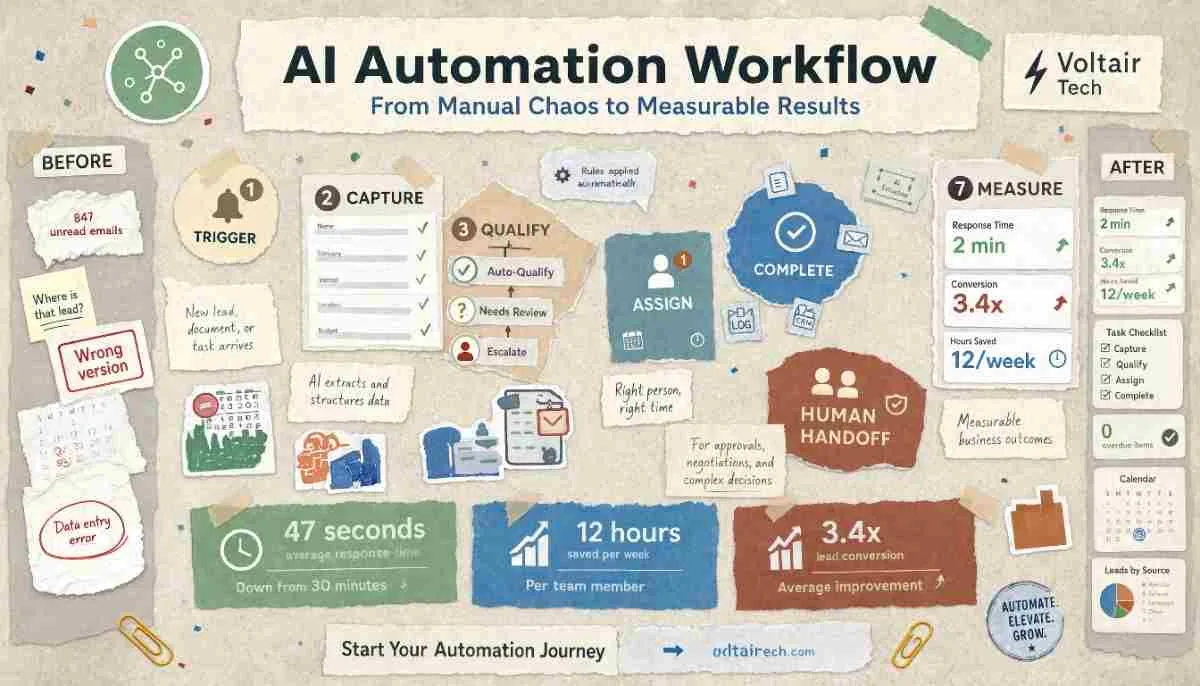
Quick answer: AI automation is most useful when the business has a repeated, measurable workflow that currently depends on manual coordination, scattered information or delayed handoffs. Start with one clearly defined process, decide what should remain human-led, and measure the result before expanding into a broader programme. ## At a glance | Question | Short answer | |---|---| | Best for | Businesses with repeated manual work across people, tools and data | | Start with | One workflow linked to a measurable business outcome | | Keep human | Final approvals, pricing, complex complaints and high-stakes decisions | | Measure | Response time, turnaround time, errors, hours saved or revenue impact | | Next step | Map the current process before selecting tools | ## The business problem Businesses rarely need technology for its own sake. They need a reliable way to move work from a trigger to a useful outcome. The right first question is not, “Which AI tool should we buy?” It is: Where does the current workflow create the most avoidable delay, manual effort or loss of visibility? ## Why the current process breaks
text Request, lead, document or task arrives → Information sits in a personal chat, inbox or spreadsheet → Ownership is unclear → A manual step is delayed or forgotten → No exception is flagged → The final outcome is not recordedThis is usually a workflow-design problem before it is a technology problem. ## How the workflow should work ```text Clear trigger → Required information captured → Rules or qualification applied → Correct owner or system notified → Repeatable task completed → Human handoff for exceptions → Outcome recorded and measured
Frequently asked questions
Is AI automation suitable for a small business?
It can be suitable when the process is repeated, the team loses time or visibility, and there is a clear owner for the workflow. Starting with one focused process is usually safer than trying to automate everything.
Do we need to replace our existing systems?
Not always. Many projects begin by connecting tools a business already uses, such as spreadsheets, CRM, email, databases, forms, internal tools or approved APIs.
How should we measure success?
Measure the specific outcome connected to the workflow: response time, completion rate, turnaround time, error rate, unassigned work, recovered tasks, team hours or relevant commercial results.
What if the workflow makes an error?
Important workflows should include validation, error alerts, logs, exception handling and human review for significant decisions.