RAG for Indian Businesses in 2026: When a Chatbot Needs Your Documents, Not Generic AI
Retrieval-Augmented Generation (RAG) is the pattern Indian businesses use when answers must be grounded in their own documents policies, SOPs, product catalogs, and legal docs instead of generic AI knowledge. This guide explains when RAG is necessary, how it works in plain language, and how to evaluate cost, timeline, and reliability for Indian teams.
RAG for Indian Businesses in 2026: When a Chatbot Needs Your Documents, Not Generic AI
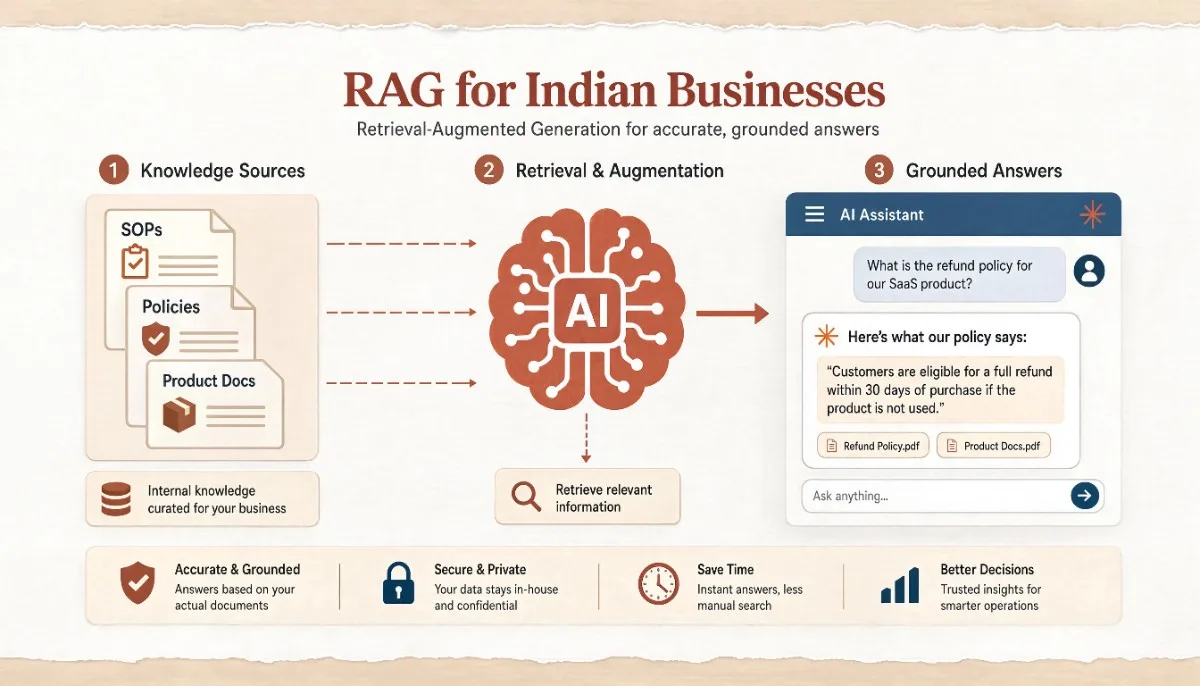
Retrieval-Augmented Generation (RAG) is an AI pattern where a chatbot retrieves your company documents—policies, SOPs, product catalogs, legal docs—and uses them to answer questions, instead of relying only on generic AI knowledge. Indian businesses use RAG when accuracy, citations, and control over answers matter more than speed alone. [32][36]
If your team spends hours searching for the right SOP, policy clause, or product spec, or if your support team repeatedly answers the same questions from manuals and FAQs, RAG is likely a better fit than a basic chatbot.
Who should consider RAG?
RAG is most valuable when:
- Answers must be grounded in your own documents, not general internet knowledge.
- Your content changes frequently (pricing, policies, SOPs, product specs).
- Wrong answers carry compliance, safety, or revenue risk.
- You need citations so users can verify the source of each answer.
Typical Indian use cases:
- Manufacturing: shop-floor SOPs, safety procedures, quality manuals.
- CA/law firms: engagement letters, compliance checklists, past memos.
- BFSI: product brochures, policy wordings, KYC/AML guidelines.
- Healthcare: treatment protocols, discharge instructions, insurance tie-ups.
- SaaS: product documentation, release notes, integration guides.
- Logistics: rate cards, SLAs, standard operating procedures for dispatch and claims.
RAG vs basic chatbot vs fine-tuning
Use this simple decision framework.
| Use case | Data grounding needed? | Update frequency | Hallucination risk | Typical cost | Typical timeline |
|---|---|---|---|---|---|
| Basic chatbot (FAQ, lead capture) | Low | Low | Medium | Lower | 1–2 weeks |
| RAG system (SOPs, policies, product docs) | High | Medium–High | Lower (with citations & fallback) | Medium | 2–4 weeks |
| Fine-tuned model (style, domain language, narrow tasks) | Medium | Low–Medium | Medium | Higher | 4–8+ weeks |
Rule of thumb:
- Choose a basic chatbot for simple FAQs and lead capture.
- Choose RAG when answers must be tied to your documents and kept up to date.
- Choose fine-tuning mainly for style, tone, or narrow domain tasks—not as a substitute for document grounding. [36][40]
When RAG is necessary
RAG becomes necessary when:
-
Accuracy matters more than speed
Compliance answers, safety procedures, pricing, and legal clauses cannot be “approximately right.” -
Your knowledge lives in documents
SOPs, policy PDFs, product manuals, rate cards, past memos, and internal wikis. -
Content changes often
Pricing updates, policy revisions, new product launches, or process changes every few weeks. -
Users need to verify sources
Employees, customers, or partners must be able to click through to the exact clause, section, or page. -
You need controlled access
Different teams should see different documents (HR policies vs engineering SOPs vs client-specific playbooks).
How RAG works (plain-language architecture)
At a high level, a RAG system does the following:
-
Document ingestion
You upload or connect documents: PDFs, Word files, Confluence/Notion pages, Google Docs, product docs, SOPs, policies, etc. -
Cleaning and chunking
The system cleans the text (removes headers/footers, normalizes formatting) and splits it into meaningful chunks (by section, heading, or logical unit). -
Embedding
Each chunk is converted into a numerical representation (embedding) that captures its meaning. These embeddings are stored in a vector database. -
Retrieval at query time
When a user asks a question, the system:- Converts the question into an embedding.
- Searches the vector database for the most relevant chunks.
- Retrieves the top-k chunks as “evidence.”
-
Grounded generation
The AI model generates an answer conditioned on the retrieved chunks, not just on its pre-trained knowledge. Good RAG systems also:- Show citations (document name, section, page).
- Indicate confidence or fallback when evidence is weak.
- Escalate to a human when the question is outside the covered knowledge.
-
Update process
When documents change, the affected chunks are re-ingested and re-embedded so future answers reflect the latest version.
Evaluation and reliability
A production RAG system must be evaluated, not just deployed.
Key evaluation questions:
- Coverage: For a sample of real questions, does the system retrieve the right documents?
- Correctness: Are the generated answers factually aligned with the source chunks?
- Citation quality: Do the citations point to the correct document, section, and page?
- Fallback behavior: Does the system admit “I don’t know” or escalate when evidence is insufficient?
- Update latency: How quickly do answers reflect document changes?
Practical evaluation workflow:
- Collect 50–200 real questions from support tickets, internal chats, or past queries.
- For each question, define the “gold” source document(s) and expected answer.
- Run the RAG system and measure:
- Retrieval accuracy (did it fetch the right chunks?)
- Answer correctness (does the answer match the gold source?)
- Citation accuracy (are the references correct?)
- Iterate on chunking strategy, retrieval parameters, and prompt design until performance is acceptable.
For Indian teams, it’s often useful to evaluate separately for English, Hindi, and other local languages if multilingual support is required.
Cost and timeline vs basic chatbots
Indicative ranges for Indian businesses (will vary by scope, integrations, and evaluation rigor):
| System type | Typical setup time | One-time build cost | Monthly running cost | Key cost drivers |
|---|---|---|---|---|
| Basic chatbot (FAQ, lead capture) | 1–2 weeks | Lower | Low–Medium | Number of flows, channels, integrations |
| RAG system (SOPs, policies, product docs) | 2–4 weeks | Medium | Medium | Document volume, chunking strategy, evaluation, access control |
| Fine-tuned model (style, narrow domain) | 4–8+ weeks | Higher | Higher | Data preparation, training runs, ongoing monitoring |
Cost drivers for RAG:
- Number and complexity of documents (PDFs with tables, scanned images, multi-language).
- Need for access control (role-based document visibility).
- Integration requirements (CRM, ticketing, internal wikis, SSO).
- Evaluation rigor (size of test set, human review loops).
- Multilingual support (Hindi, Marathi, Tamil, etc.).
Mini case examples
1. Manufacturing SOP assistant
Context: A Pune-based manufacturer with 200+ shop-floor SOPs in PDF and Word.
Problem: Operators and supervisors spend 15–30 minutes per shift searching for the right procedure, especially for non-routine tasks and quality checks.
RAG solution:
- Ingested 200+ SOPs, quality manuals, and safety procedures.
- Chunked by process step and hazard type.
- Deployed as a web and mobile assistant for shop-floor teams.
- Added citations to document name, section, and revision date.
Outcome:
- Search time reduced from 15–30 minutes to under 1 minute.
- Fewer deviations and rework due to incorrect or outdated procedures.
- Easier onboarding for new operators.
2. CA firm document search and client query assistant
Context: A Mumbai CA firm with hundreds of engagement letters, compliance checklists, and internal memos.
Problem: Junior staff spend hours locating the right clause or past treatment for similar clients; partners repeat explanations on common compliance questions.
RAG solution:
- Ingested engagement letters, checklists, past memos, and standard response templates.
- Built role-based access (partners vs juniors vs interns).
- Added a client-facing assistant for common GST, TDS, and compliance FAQs, grounded in the firm’s own write-ups.
Outcome:
- Faster research time for juniors.
- More consistent answers across the team.
- Partners freed from repetitive explanatory calls.
3. SaaS in-product help grounded in docs
Context: A Bengaluru SaaS startup with extensive product documentation and release notes.
Problem: Users struggle to find relevant docs; support tickets are dominated by “how-to” questions already covered in documentation.
RAG solution:
- Connected product docs, release notes, and integration guides.
- Embedded the assistant inside the product as a help widget.
- Showed citations linking directly to the relevant doc section.
Outcome:
- Reduction in “how-to” support tickets.
- Higher self-serve adoption of advanced features.
- Better alignment between product updates and user understanding.
Risks and decision criteria
RAG is powerful but not a magic bullet. Consider:
- Document quality: Garbage in, garbage out. Poorly structured or outdated docs will produce poor answers.
- Hallucinations: RAG reduces but does not eliminate hallucinations; evaluation and fallback are essential.
- Access control: Ensure sensitive documents are visible only to authorized users.
- Change management: Teams must commit to keeping source documents up to date.
- Integration complexity: Connecting to internal wikis, ticketing systems, or CRMs can add time and cost.
Decision checklist:
- Do you have a clear set of source documents?
- Are those documents reasonably structured and maintained?
- Do wrong answers carry meaningful risk (compliance, safety, revenue)?
- Are you willing to invest in evaluation and ongoing document hygiene?
If the answer to most of these is “yes,” RAG is likely a strong fit.
Frequently asked questions
What is RAG in simple terms?
Retrieval-Augmented Generation (RAG) is an AI pattern where a chatbot first retrieves relevant parts of your own documents and then uses them to generate answers, keeping responses grounded in your knowledge.
When should we choose RAG over a basic chatbot?
Choose RAG when answers must be tied to your specific documents, content changes often, and wrong answers carry compliance, safety, or revenue risk.
How long does a RAG project take in India?
Typical pilots take 2–4 weeks; larger multi-domain deployments can take 6–10 weeks depending on document volume, integrations, and evaluation rigor.
What are the risks of RAG?
Poor document quality, outdated content, residual hallucinations, and inadequate access control. These are managed through document hygiene, evaluation, citations, and fallback behavior.
How do we keep answers up to date?
By re-ingesting and re-embedding documents whenever they change, and tracking document versions and update timestamps for each answer’s source.
Can RAG support Hindi and other Indian languages?
Yes, but evaluation should be done separately for each language, and embedding/retrieval strategies may need tuning for Hindi, Marathi, Tamil, and other Indian languages.